7Os Model: Understand Customers with 7 Questions, with a Prompt Guideline and a Downloadable Worksheet
Before designing a product, setting a price or running ads, you need to know who your customers are, what they buy, why, who else takes part in the decision, how, when and where they buy. The 7Os Model puts all 7 questions in one framework. This article shows what data to give AI, with prompts to copy and a blank worksheet to download for workshops.


What is the 7Os Model
The 7Os Model is a framework for analysing a market and consumer behaviour through 7 questions whose answers start with the letter O: Occupants, Objects, Objectives, Organizations, Operations, Occasions and Outlets. Marketing texts often credit Philip Kotler with the idea, while Thai marketing textbooks usually call it 6W1H, because the questions are Who, What, Why, Who, How, When and Where. Its strength is that it looks from the marketer's side at what you need to know about customers before deciding on product, price, channels and communication.
What the 7Os Model looks like
Every question revolves around one customer group. The 7 questions cover who, what, why, who else decides, how, when and where. Tap an O to see its explanation, example and prompt.
Prompt Guideline: the data to prepare for AI to analyse the 7Os
If you only ask AI to "do the 7Os for my dessert shop", you get an answer that fits any shop, because AI does not know your customers. Prepare these 8 topics first. The numbers in the last column show which O each one answers.
| Data to prepare | Examples of what to include | Where to find it | Used for O |
|---|---|---|---|
| The product or service to analyse | Pick one product or product group, with price and size | Where to find itProduct list, menu, quotes | |
| Data on customers who actually buy | Age, occupation, location, individual or company, repeat buyer or not | Where to find itLINE OA chats, order history, page insights | |
| Customers' own words | Reasons for buying, praise, complaints, questions before buying | Where to find itChats, reviews, comments, interviews with 5 to 10 customers | |
| Who is involved in ordering | Who makes contact, who approves, who pays, who actually uses it | Where to find itCorporate customer chats, quote emails | |
| The actual buying steps | How customers found you, who they compared you with, how they order and pay, how many days it takes | Where to find itChats from first contact to closed sale | |
| Days and times of purchase | Daily or monthly sales, festivals, paydays, company budget cycles | Where to find itSales reports, accounting software, POS system | |
| Channels where customers buy | Sales by channel, channels customers ask for | Where to find itPlatform reports, LINE OA Manager, delivery apps | |
| A completed 7Os worksheet | If you run a workshop with your team, type the worksheet answers straight into the prompt | Where to find itThe PDF worksheet in this article |
6 rules before you paste data into AI
- 01Analyse one customer group at a timeIndividual and corporate customers answer the 7 questions differently. Do one group at a time, then compare.
- 02Use customers' real wordsPaste real chat or review text. AI will see buying reasons more accurately than from the owner's opinion.
- 03State the amount and time periodFor example, 40 chats in October. AI then knows how much data there is and does not compare the wrong periods.
- 04Separate facts from guessesLabel which points come from data and which are feelings, and tell AI to do the same
- 05Remove personal dataRemove customer names, phone numbers, addresses and company names before pasting into AI
- 06End with a decisionEvery insight should lead to something you will change, such as product, price, channel or ad message
No data yet? Let AI interview you first
AI asks one question at a time for one customer group, and tells you how to find missing data cheaply
Act as a marketing consultant using the 7Os model of consumer behaviour (Occupants, Objects, Objectives, Organizations, Operations, Occasions, Outlets).
Interview me ONE question at a time, in Thai, to collect what you need for ONE customer group, one O at a time.
If I do not know an answer, tell me how to find it cheaply (chats, reviews, sales reports, short customer interviews) and move on. When done, summarise my answers under the 7 Os and list what is still missing. Do not give recommendations yet.
Have the data? Analyse all 7
Summarises the insight for each O, rates how reliable the data is, and picks the 3 most important insights
Act as a marketing consultant. Analyse my customers with the 7Os model using ONLY the data below.

Business and product: [DESCRIBE]
Customer group: [INDIVIDUAL OR CORPORATE, WHO]
1. Occupants (who): [PASTE]
2. Objects (what): [PASTE]
3. Objectives (why): [PASTE]
4. Organizations (who takes part in the decision): [PASTE]
5. Operations (how they buy): [PASTE]
6. Occasions (when): [PASTE]
7. Outlets (where): [PASTE]

For each O: summarise the key insight in one line and rate how confident the data is (high, medium, low). Then list the 3 most important insights and what data is missing.
Answer in Thai, in short bullet points a beginner can act on. For every point, say which data it comes from, mark anything that is a guess, and never invent numbers.
The 7 questions of the 7Os, with examples
The example is a homemade Thai dessert shop selling online through LINE OA, the same fictional shop used in the BMC, SWOT, 3Cs and 4P/7P articles. It compares 2 customer groups, individual customers and companies ordering meeting snack sets, and the answers differ a lot, especially for Organizations.
1Who the customer isOccupants · WHO
Know as clearly as possible who your customers are: demographics such as age, occupation, income and location, plus lifestyle. If there are several groups, see which buys the most or is the most profitable. You can take this further with STP segmentation.
- Who actually buys, and is it different from what you assumed?
- How many customer groups are there, and which matters most?
Informs: Choosing the target group and positioning
Help me answer OCCUPANTS (who is the customer) in the 7Os model.
My business and the product I am analysing: [DESCRIBE]
Customer group: [INDIVIDUAL OR CORPORATE, WHO]
Customer data I have (orders, chats, page insights, with months): [PASTE]
Describe who my real customers are, split them into groups, and tell me which group matters most and why. Point out where my assumptions differ from the data.
Answer in Thai, in short bullet points a beginner can act on. For every point, say which data it comes from, mark anything that is a guess, and never invent numbers.
2What customers buyObjects · WHAT
What customers really buy from you: the product, size, quantity, packaging and the features they look for. Sometimes what they buy is not the product but the convenience or the feeling it gives.
- Which product and size sells best?
- Which feature makes customers choose you?
Informs: Product and Physical Evidence
Help me answer OBJECTS (what customers buy) in the 7Os model.
My business and the product I am analysing: [DESCRIBE]
Customer group: [INDIVIDUAL OR CORPORATE, WHO]
Sales by product and size (with months): [PASTE]
What customers say about the products: [PASTE]
Tell me what customers are really buying, including the hidden benefit behind the product, and which items or sizes to push or drop.
Answer in Thai, in short bullet points a beginner can act on. For every point, say which data it comes from, mark anything that is a guess, and never invent numbers.
3Why customers buyObjectives · WHY
What customers buy for, what problem they want solved or what feeling they want. There are functional reasons, such as saving time, and emotional ones, such as wanting the gift recipient to be impressed. This is the most direct input for ad copy.
- What problem do customers buy to solve?
- How do customers want to feel after buying?
Informs: The key message in Promotion and the value of the Product
Help me answer OBJECTIVES (why customers buy) in the 7Os model.
My business and the product I am analysing: [DESCRIBE]
Customer group: [INDIVIDUAL OR CORPORATE, WHO]
Customer quotes from chats, reviews or interviews: [PASTE]
Group the reasons into functional and emotional motives, rank them by how often they appear, and suggest one key message for my promotion based on the top motive.
Answer in Thai, in short bullet points a beginner can act on. For every point, say which data it comes from, mark anything that is a guess, and never invent numbers.
4Who else decidesOrganizations · WHO ELSE
Everyone who takes part in the buying decision: initiator, influencer, decider, buyer or payer, and user. An individual may decide alone, but a company usually involves several people, so you need to address the right ones.
- Who makes contact, who approves, and who gets to use it?
- What does each person care about?
Informs: Who to address in Promotion and People
Help me answer ORGANIZATIONS (who takes part in the buying decision) in the 7Os model.
My business and the product I am analysing: [DESCRIBE]
Customer group: [INDIVIDUAL OR CORPORATE, WHO]
What I know about who contacts me, who approves and who pays: [PASTE]
Map the roles (initiator, influencer, decider, buyer, user), what each one cares about, and what I should say or provide to each role so the order goes through.
Answer in Thai, in short bullet points a beginner can act on. For every point, say which data it comes from, mark anything that is a guess, and never invent numbers.
5How customers buyOperations · HOW
How customers buy, from discovering you, searching and comparing to deciding, ordering, paying and receiving. The steps that are hard or where customers drop off are what to fix first.
- How do customers find you, and who do they compare you with?
- Where do ordering and payment get stuck?
Informs: Process, and payment methods under Price
Help me answer OPERATIONS (how customers buy) in the 7Os model.
My business and the product I am analysing: [DESCRIBE]
Customer group: [INDIVIDUAL OR CORPORATE, WHO]
Chats from first contact to closed sale (anonymised): [PASTE]
Map the buying steps, show where customers hesitate or drop off, and suggest the 3 simplest fixes.
Answer in Thai, in short bullet points a beginner can act on. For every point, say which data it comes from, mark anything that is a guess, and never invent numbers.
6When customers buyOccasions · WHEN
When customers buy: day of the week, time of day, festivals, seasons, paydays or company budget cycles, and how often. This helps you time promotions and prepare stock more accurately.
- When do sales peak, and when are they quiet?
- How many days or months between repeat purchases?
Informs: Promotion timing and the content calendar
Help me answer OCCASIONS (when customers buy) in the 7Os model.
My business and the product I am analysing: [DESCRIBE]
Customer group: [INDIVIDUAL OR CORPORATE, WHO]
Sales by day, week or month (with dates): [PASTE]
Festivals or events that matter to my customers: [LIST]
Find the buying patterns and repeat cycle, then suggest a 3-month promotion calendar based only on these patterns.
Answer in Thai, in short bullet points a beginner can act on. For every point, say which data it comes from, mark anything that is a guess, and never invent numbers.
7Where customers buyOutlets · WHERE
Where customers buy and where they would like to buy: a shop, website, LINE OA, delivery apps, marketplaces or resellers. Look at both sales and the profit left after each channel's fees.
- Which channel sells the most, and how much profit is left?
- Which channels do customers ask you to add?
Informs: Place, or sales channels
Help me answer OUTLETS (where customers buy) in the 7Os model.
My business and the product I am analysing: [DESCRIBE]
Customer group: [INDIVIDUAL OR CORPORATE, WHO]
Sales and fees by channel (with months): [PASTE]
Channels customers ask for: [PASTE]
Rank my channels by sales, profit after fees and fit with each customer group, and tell me which to grow, keep or drop.
Answer in Thai, in short bullet points a beginner can act on. For every point, say which data it comes from, mark anything that is a guess, and never invent numbers.
Download the 7Os worksheet for your workshop
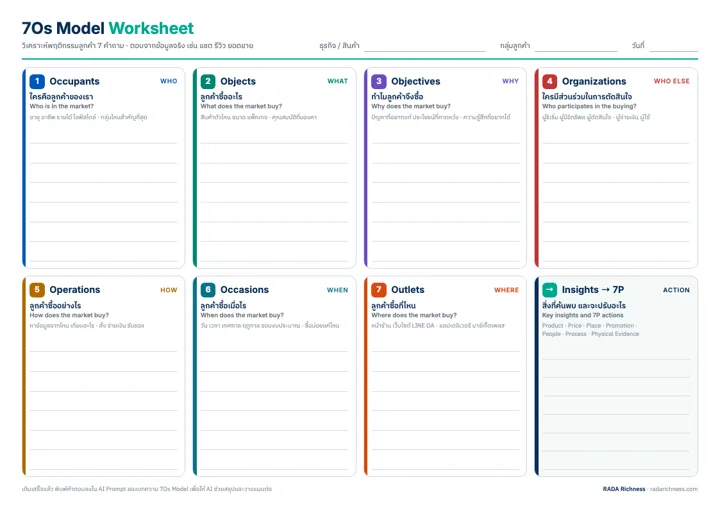
Want to do the 7Os with your team or in a class? Download the blank worksheet and print it for free. Once it is filled in, use the AI prompts below to summarise the results.
A blank 7Os worksheet, ready to print for workshops
A one-page A4 landscape worksheet with all 7 boxes and guiding questions, plus a box for turning insights into 7P actions. Use it alone or as a team.
- Print one worksheet per customer group
- Split into teams and fill in answers from real data such as chats, reviews and sales, about 5 minutes per box
- Type the answers into the "Summarise the workshop worksheet" prompt below and let AI organise them
- Fill in the Insights → 7P box with what you will change, then use the "Turn insights into a 7P plan" prompt
Summarise the workshop worksheet
AI merges the team's answers, separates facts from opinions, and flags weak boxes
We filled in the 7Os worksheet in a team workshop. Here are our answers:
[TYPE THE ANSWERS FROM EACH BOX]
Business: [DESCRIBE]
Clean up our answers, merge duplicates, separate facts from opinions, and point out boxes that are weak or contradict each other. Then suggest what to check with real customers before we act.
Answer in Thai, in short bullet points a beginner can act on. For every point, say which data it comes from, mark anything that is a guess, and never invent numbers.
Turn insights into a 7P plan
Links each insight to the P to change, then picks the 3 changes worth the most
Here is my 7Os analysis:
[PASTE]
Turn each insight into marketing mix decisions: which P it affects (Product, Price, Place, Promotion, People, Process, Physical Evidence) and one concrete change. Then pick the 3 changes with the biggest impact for the least money and give one number to track for each. Leave cost cells empty for me to fill.
Answer in Thai, in short bullet points a beginner can act on. For every point, say which data it comes from, mark anything that is a guess, and never invent numbers.
From the 7Os to the 7P Marketing Mix
The 7Os are about understanding customers; the 7Ps are what the business does. Each O answers a question that informs these decisions:
Take Occupants further with market segmentation in STP For the 7 decision areas in detail, see Marketing Mix 4P / 7P and for the whole-business view, see Business Model Canvas
Mistakes beginners often make
- Lumping every customer group into one answer until the insights are too broad to use
- Answering from the owner's gut feeling without looking at real chats, reviews or sales
- Forgetting Organizations for corporate customers: talking to whoever made contact but giving nothing to the approver
- Finishing the analysis without linking it to decisions, so product, price, channels and ad messages stay the same
- Doing it once and never reviewing it, even though customer behaviour changes with seasons and new channels
Checklist before you use it
- Pick one customer group and one product before you start
- Every answer comes from real data such as chats, reviews, sales or interviews
- For corporate customers, you have named who initiates, approves, pays and uses
- Remove customers' personal data before pasting into AI
- Every insight links to at least one 7P change
- Schedule a 7Os review every quarter or whenever you open a new channel
References: Business Jargons: 7 O's Framework for Consumer Behavior, Think Insights: 7Os Framework for Consumer Behavior, Tumtook: What are the 7Os (Thai), 7 O's Model summary (citing Siriwan Serirat, 2003, Thai)The attribution to Philip Kotler comes from secondary sources and has not been checked against the original book · The business in this article is fictional. AI analysis is a suggestion to consider; check it against real data before making investment decisions.
Share it with a friend who is starting a business. Share to Facebook Share on LINE